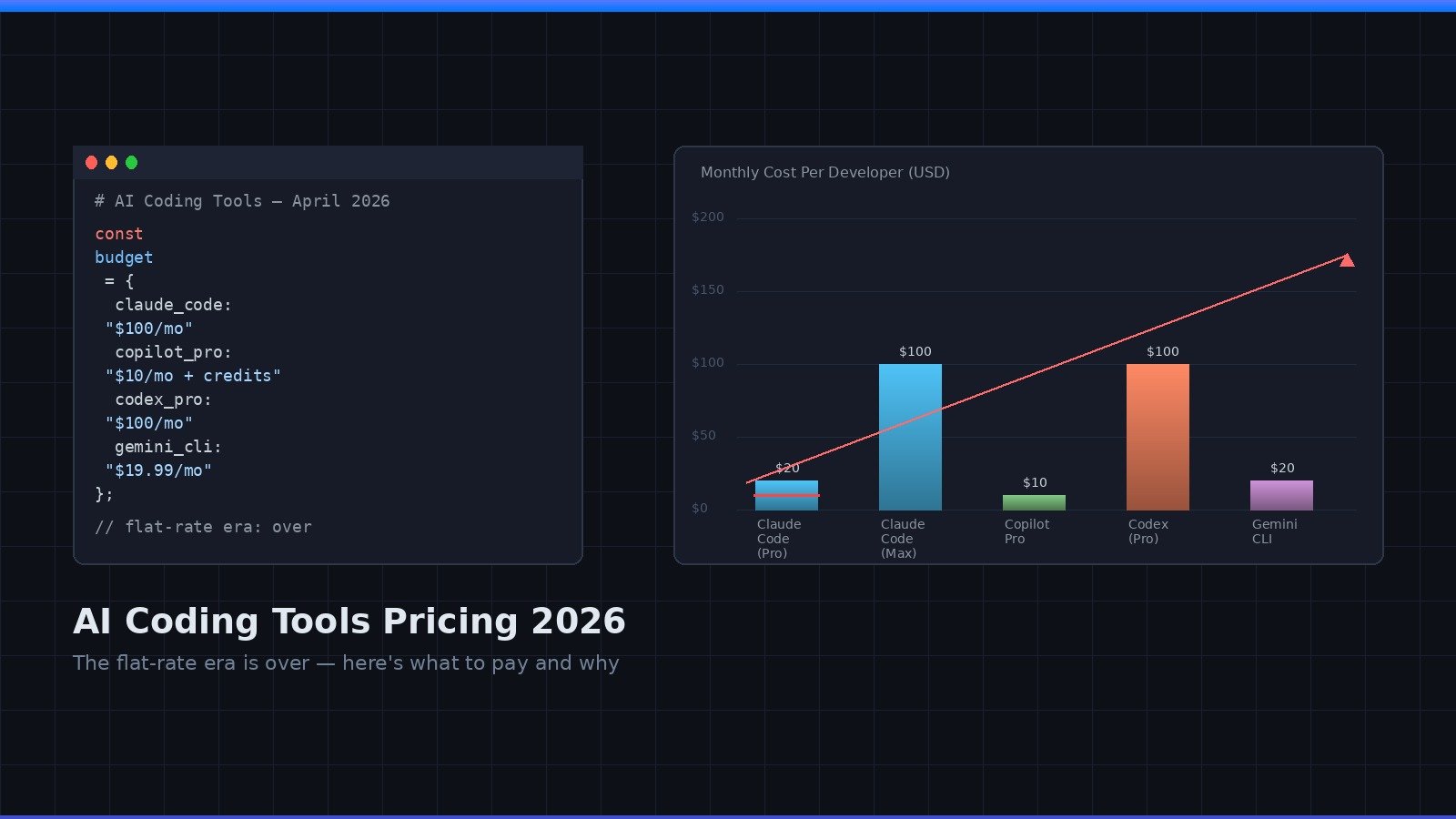
The week of April 21, 2026 was expensive for a lot of developers. Anthropic removed Claude Code from the $20 Pro plan. A day later, GitHub froze new signups for Copilot Pro. OpenAI had already rolled out a $100 Pro tier on April 9. Google folded Gemini CLI into its $19.99 AI Pro subscription. In the span of a few days, the flat-rate AI coding era — where $20 a month covered everything — effectively ended. For solo developers and engineering teams, this means the tool budget conversation has to start over.
Here is where the major tools stand as of late April 2026:
| Tool |
Old price |
New price |
What changed |
| Claude Code |
$20/month (Pro) |
$20 (Pro, capped) / $100 (Max 5x) |
Removed from $20 Pro plan April 21 |
| GitHub Copilot |
$10–$39/month |
$10 (Pro) / $39 (Pro+) |
Token-based "AI Credits" from June 1 |
| OpenAI Codex |
$20/month (Plus) |
$20 (Plus, capped) / $100 (Pro tier) |
$100 Pro tier launched April 9 |
| Gemini CLI |
Included in Google One |
$19.99/month (AI Pro) |
Folded into AI Pro subscription |
The Claude Code situation deserves more detail. Through March 2026, you could run it on the $20 Pro plan. Then in late March, Anthropic acknowledged that "people are hitting usage limits in Claude Code way faster than expected" and called it their top priority. On April 21, Pro plan users lost access. The Max plan at $100/month (Max 5x) gives five times the Pro usage per session. A Max 2x plan also exists for lower-volume users. For teams with higher throughput, Anthropic's API billing remains available — and for some usage profiles, direct API billing will be cheaper than a flat subscription. You can read a full breakdown of OpenAI's Codex agentic capabilities if you are evaluating Codex as an alternative.
GitHub Copilot's change is more subtle but could cost more over time. Starting June 1, Business and Enterprise plans will replace fixed "premium request units" with "AI Credits" based on actual token consumption. If your team is running heavy agentic tasks, the bill may climb even if seat count stays flat.
The root cause is simple: agentic workflows fundamentally changed how tokens are consumed.
In 2024, a typical developer made around 50 API calls per day — mostly single-turn completions. In 2026, a developer running Claude Code or agentic Codex on a medium-sized codebase can generate thousands of API calls in a session. Each multi-agent run spawns independent context windows. A three-agent Claude Code session running for an hour can consume what a single-agent session used in a full day. When every major tool shipped multi-agent capabilities in the same two-week window in February 2026 — Windsurf with five parallel agents, Grok Build with eight, Claude Code Agent Teams, Codex CLI's Agents SDK — the consumption curve jumped sharply.
SemiAnalysis estimates Claude Code accounts for roughly 4% of all public GitHub commits as of March 2026. Developers who upgraded to agentic workflows did not just change how they code — they changed how much compute they consume. Vendors had no choice but to restructure. The flat-rate model was priced for autocomplete, not autonomous agents editing files, running tests, and coordinating across a codebase.
What is the token cost breakdown for Claude Code vs GitHub Copilot?#
If you are evaluating plans, consumption volume is the variable that matters. Here is the rough breakdown for Claude Code:
Light user (autocomplete, occasional file edits, no multi-agent work): Likely stays under Pro limits. The $20 plan may still work depending on how Anthropic reconfigures capped access.
Moderate user (daily agentic sessions, single-agent workflows, file reads and test runs): Typically lands in the $100–200/month range on API billing. The Max 5x plan at $100 can be a better deal than raw API usage if you are consistently hitting daily limits.
Heavy user (parallel agent teams, large codebases, multi-hour agentic sessions): Run a week on API billing before committing to any plan. Claude Code's usage data shows that over 90% of total tokens in a typical session are cache reads, so actual variable cost depends more on how many new input tokens you generate than on raw output volume.
The worst outcome is paying for Max without needing it, or staying on a capped plan and getting blocked mid-task.
For individual developers doing casual AI-assisted coding, stay on the lowest plan available and resist upgrading until you have concrete evidence you are hitting limits. A week of actual usage data is worth more than any vendor pricing guide.
For individual developers running daily Claude Code or Codex agentic workflows, track your API usage for five to seven days. If you are consistently over $15/week in API costs, the $100 Max plan is likely the better value. If you are under that threshold, stay on API billing.
For engineering leads evaluating team tooling, the move to AI Credits on Copilot means you need to budget for token volume, not just seats. Run a two-week pilot with telemetry before signing enterprise contracts. Claude Code team accounts and GitHub Copilot Enterprise both offer usage audit logs — use them before committing.
For teams running multi-agent orchestration, cost management becomes a first-class engineering concern. Tracking token consumption per session, per task, and per agent is worth setting up early. We covered event-driven monitoring patterns for Claude Code that can help here: Claude Code monitor tool and event-driven workflows.
The most effective lever is context window hygiene. Agentic tools often read your entire repository at the start of a session and re-read modified files after each action. Keeping irrelevant files out of the agent's scope — using .claudeignore or equivalent exclusion files — can cut token consumption by 20–40% in large monorepos. This is the single highest-ROI change most teams can make immediately.
The second lever is task decomposition. Long-running agentic sessions that drift in scope generate far more tokens than short, focused sessions targeting one component at a time. Structured prompts that define scope upfront reduce unnecessary exploration.
Third, work with the caching model. Claude Code uses prompt caching heavily — over 90% of tokens in a typical session are cache reads. Structuring workflows to reuse system prompts and stable context blocks keeps input token costs low.
Finally, apply AI code review selectively rather than on every commit. Running agents on every diff without filtering creates real cost without proportional value, especially on high-velocity teams.
What I Would Do#
For most developers, the right move is to spend one week on API billing and measure. Do not commit to any subscription tier until you have real usage data. Anthropic's API dashboard and GitHub's Copilot usage analytics both give enough granularity to project monthly costs accurately.
For engineering leads, treat the tool budget like you treat cloud infrastructure: set a monthly ceiling, track consumption against it weekly, and adjust as workflows evolve. The tools themselves will keep changing. Gemini CLI continues closing the gap on Claude Code and Codex for structured agent tasks, and pricing competition will shift again as the market matures.
The $20 era is gone. But that does not mean agentic AI coding tools are not worth the new prices. It means you need to be intentional about what you are running and when. Measure first, then decide.
 By Amaresh Adak7 min read
Comments
Sign in to join the discussion.
No comments yet. Be the first to share your thoughts.