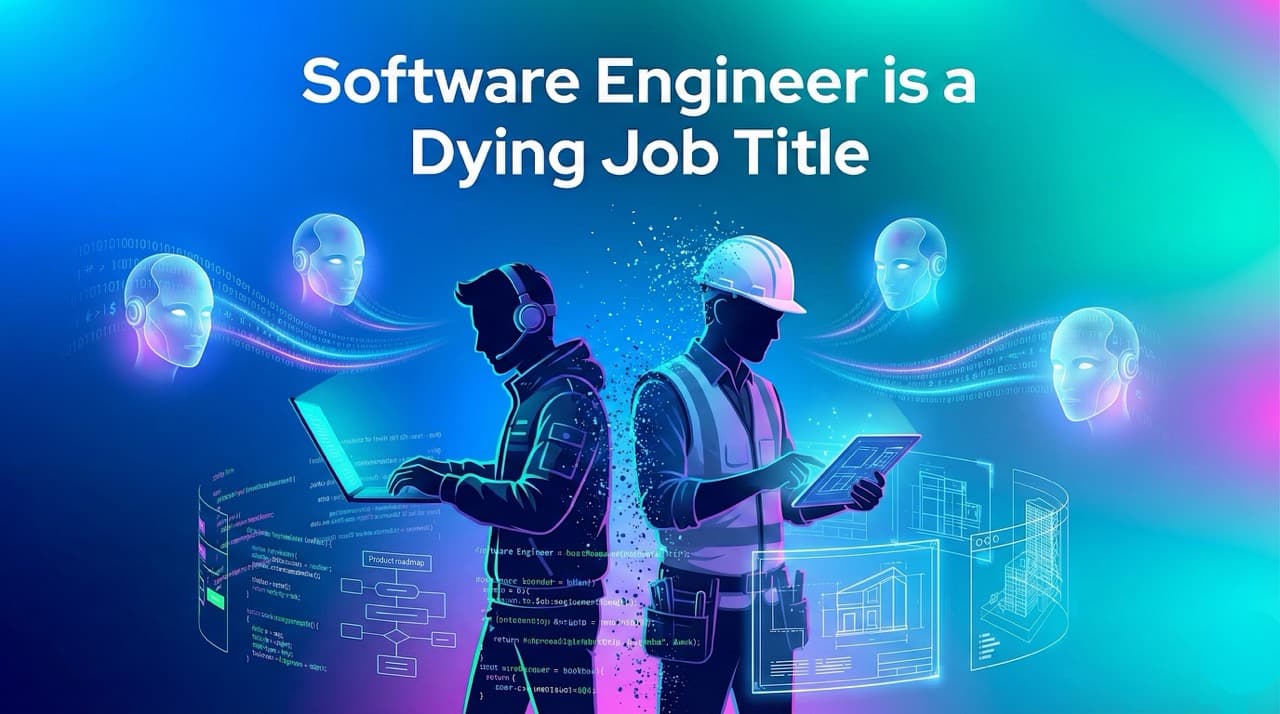
Here's something that stopped me mid-scroll last week: Boris Cherny, the guy who literally built Claude Code at Anthropic, went on Y Combinator's Lightcone podcast and said the title "software engineer" is going to start disappearing in 2026.
Not eventually. Not someday. 2026.
His prediction? We'll be called "builders" or "product managers." Maybe we'll keep the old title the way we keep "webmaster" alive — technically still a word, but nobody actually uses it.
I've been writing code professionally for six years. That hit differently.
What Cherny Actually Said#
His argument isn't that developers are getting fired. It's more subtle — and honestly more unsettling.
He says coding is becoming a universal skill. Not "anyone can learn to code" universal, but "AI will write the code, so everyone who understands what to build now codes" universal. At Anthropic, every team function already writes code: PMs, designers, data scientists, finance people. The line between "technical" and "non-technical" is blurring fast.
"Someone has to prompt the Claudes, talk to customers, coordinate with other teams, decide what to build next," he wrote on X. "Engineering is changing and great engineers are more important than ever."
That last part sounds reassuring. Whether it actually is depends on which side of "great" you're on.
He's not theorizing from the outside, either. Over the past two months, 100% of his own code was written by Claude Code with zero manual edits. In a single day, he shipped more than 20 pull requests. All AI-generated. He's living the prediction he's making.
The Part That Actually Concerns Me#
Andrej Karpathy — who coined the term "vibe coding" — recently admitted something worth paying attention to. He's gone from 80% manual coding to 80% AI-generated code in a matter of weeks, and he's noticed his ability to write code by hand starting to decline.
That's the creator of "vibe coding" saying his coding skills are atrophying. Let that sink in.
This is the trade-off nobody talks about in the hype cycle. You get speed and output. You might quietly lose depth. The ability to debug something at 2 AM when the AI confidently gives you the wrong answer five times in a row — that skill matters. It's just getting less practiced.
Cherny acknowledged this too. He argues that the core of engineering — understanding systems, making architectural decisions, ensuring quality — stays human. The mechanical parts automate away, the thinking stays.
I want to believe that. I'm just not sure the market will pay for "thinking" the same way it pays for "building."
What This Means If You're a Developer Right Now#
A few things I keep coming back to:
The ceiling is raising. If AI can write the code, then the value you bring has to sit above the code. Product thinking, user empathy, architectural judgment, domain knowledge. These matter more now.
The floor is also raising. Non-technical people can now build things. The designer who has a feature idea doesn't need to file a ticket and wait two sprints. They can just... build it. That changes your internal leverage at every company you work at.
"Software engineer" as a title was always partly a gate. It separated people who could build from people who couldn't. That gate is coming down. What's left is the actual work — deciding what to build and making sure it's right.
Dario Amodei said at Davos that AI could handle "most, maybe all" software engineering work within six to twelve months. He said that in January 2025. The clock is running.
Where I Land On This#
I don't think developers disappear. I think the role reshapes, fast, and the people who adapt early will be fine. The people who keep their head down writing CRUD endpoints and waiting for this to blow over probably won't.
The title change, if it comes, is just the visible symptom. The real shift is that coding stops being the moat. Understanding what to code, for whom, and why — that's where the value moves.
That's actually a more interesting job description, honestly. It's just a harder one to hire for, prepare for, and measure performance on. Which is its own problem.
For now, I'm going to keep learning how to work with AI agents effectively, keep sharpening the parts of my skill set that can't be generated — system design, product thinking, debugging instincts — and see what 2026 actually looks like.
If the title changes, fine. The work has always mattered more than what we called it.
Have thoughts on this? Drop them in the comments. And if you're thinking about how to actually position yourself as a developer in this shift, I'll be writing more on that soon.
 By Amaresh Adak4 min read
Comments
Sign in to join the discussion.
No comments yet. Be the first to share your thoughts.